Posted on Tue, Jun. 10, 2008
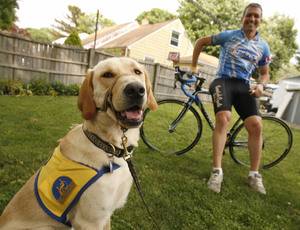
Inspired by his ill wife, he makes a long ride
Doug Levy likes to fix things. At work, it's
computers. Other times, it's people - he's an
emergency medical technician, and he raises service dogs to help those with
disabilities.
But he can't fix the biggest problem his family faces: his wife's two
chronic illnesses, multiple sclerosis and non-Hodgkin's lymphoma.
So the
For the next week or so he'll have plenty of time to reflect as he attempts
the biggest ride of his life - the 3,008-mile Race Across America, the longest
single-stage ultra-endurance bike race in the world.
Think pushing two wheels up the Manayunk Wall is
tough? Levy will be peddling a muscle-crunching 21 hours or more each day in
order to cover approximately 300 miles per day. His only reprieve will be 15 to
90 minute cat naps.
"Lance Armstrong said it best: 'Pain is temporary; quitting is
forever,' " Levy said, loading up on protein in the form of a turkey
hoagie a few days before the race.
Levy has been riding long distance since the 1990s, but as his wife's
illnesses progressed, so did the length of his spins: from 50 miles to 100 to
300 to the formidable RAAM, which started Sunday at noon in
At 53, Levy is the third-oldest solo rider in the competition, which only
179 people riding alone have completed in 26 years. (By comparison, more than
500 people reached the summit of
Carol, his wife of 30 years and a former competitive skier, is his race
manager and inspiration.
"Seeing her take the chemo and fight the cancer and fight the MS, she's
awesome," said Levy, lean and compact, who seemed strikingly laid-back
given the challenge ahead.
"This race is only 12 days. Carol's race is for life."
The couple are relentless, whether spending 21
hours a day on a bike or enduring monthly treatments to replace an immune
system killed by chemotherapy.
"Everyone in our family is very, very strong," Carol, 50, said in
the living room of their home, with four golden retrievers barely making a
whimper in the kitchen.
As volunteers with Canine Companions for
As the event neared last week, Carol Levy was the one spinning with
excitement. Clutching a cell phone, she fielded calls from Doug's backup crew,
which had reached
Whenever her husband asks about some detail, she tells him: "Yadda, yadda, yadda.
Shut up and ride. That's all that matters. The crew takes care of the
rest."
Though, for health reasons, Carol can't be in the race van, shadowing her
husband like a guardian angel, she planned to surprise him by flying out for
the start.
Their life together began in 1973 at a
He did, and they married four years later.
Her MS was diagnosed 26 years ago after she lost vision in her right eye.
She expected to be in a wheelchair by now but is still walking.
Then seven years ago, she was told she had lymphoma, which killed her mother
and sister. She is still battling the disease.
"She's a fighter like you wouldn't believe," her husband said
admiringly.
It's hard to say which of the two is tougher.
RAAM is different from nearly any other ultra-endurance race in the mental
and physical ruggedness required. It is nearly 50 percent longer than the Tour
de France. And unlike the tour, it does not allow riders to draft or ride in
packs, and there are no days off.
Moreover, riders can't sleep more than three to four hours a night if they
expect to finish in 12 days. The winners sleep even less.
Extreme-endurance athletes are a breed apart, pushing themselves beyond the
imaginable, just for the challenge.
They're "really attracted to the risk-taking, adrenaline rush of being
on the edge," said Joel Fish, director of the Center for Sports Psychology
in
That profile fits Levy, who likes to raise the bar higher with each race. In
fact, his goal is to zip across the country in 10 days, which would beat the
age 50-59 record of 10 days, 52 minutes.
As of 5 p.m. yesterday, he was just outside
After he qualified for RAAM in 2005, Levy wasn't sure he would go through
with it. A triple-amputee
As they rode together in another race, Levy told
"We had an agreement," Levy said. "He was going to cross the
finish line. He wasn't quitting, and I wasn't going to quit."
Levy trains seven days a week, leaving his house at 3:45 a.m. for a 2
1/2-hour ride to work in Exton. Then he rides home. On Saturdays and Sundays
he's in the saddle for up to 12 hours.
"I didn't know the training intensity would be so severe," he
admitted.
There's no way to prepare for the more excruciating aspects of the race,
such as hallucinations from sleep deprivation. Or tornadoes.
Or nerve and muscle damage from riding so many days. Or
collisions with cars, which have killed two RAAM riders.
Thankfully, he has Carol, who handles everything but the pedaling, including
buying custom shirts and nutrition drinks and planning menus for the crew.
The all-consuming job has cost her friends who don't understand and have
drifted away.
"I told my sister it was either support him or divorce him. . . . I
love him," she said.
Though she still isn't sure what drives him - whether he's pedaling away
from or toward something.
"But he always rides home," she said. "That's what it comes
down to."
Contact
staff writer Kathy Boccella at 610-313-8123 or kboccella@phillynews.com.